From a parcel of unfamiliar rough to a Smithsonian collection.
Tanzim Khan Malik, founder of Genuine Gems & Jewellery in Bangkok, is credited across the gemological and trade press as the discoverer of Gold Sheen Sapphire™ — the person who first recognised, cut, named, and trademarked this material as a distinct variety of corundum. Here's how that happened, and what's been written about it since.
"They didn't look like much. I was intrigued."
In 2009, with thirty years already in the gem trade and a shop in Bangkok's Silom district, Tanzim Khan was approached by a dealer offering a parcel of rough stones from a remote part of Kenya, near the Somali border. At first glance they didn't look like much — dark, opaque material, unlike any sapphire he'd handled before.
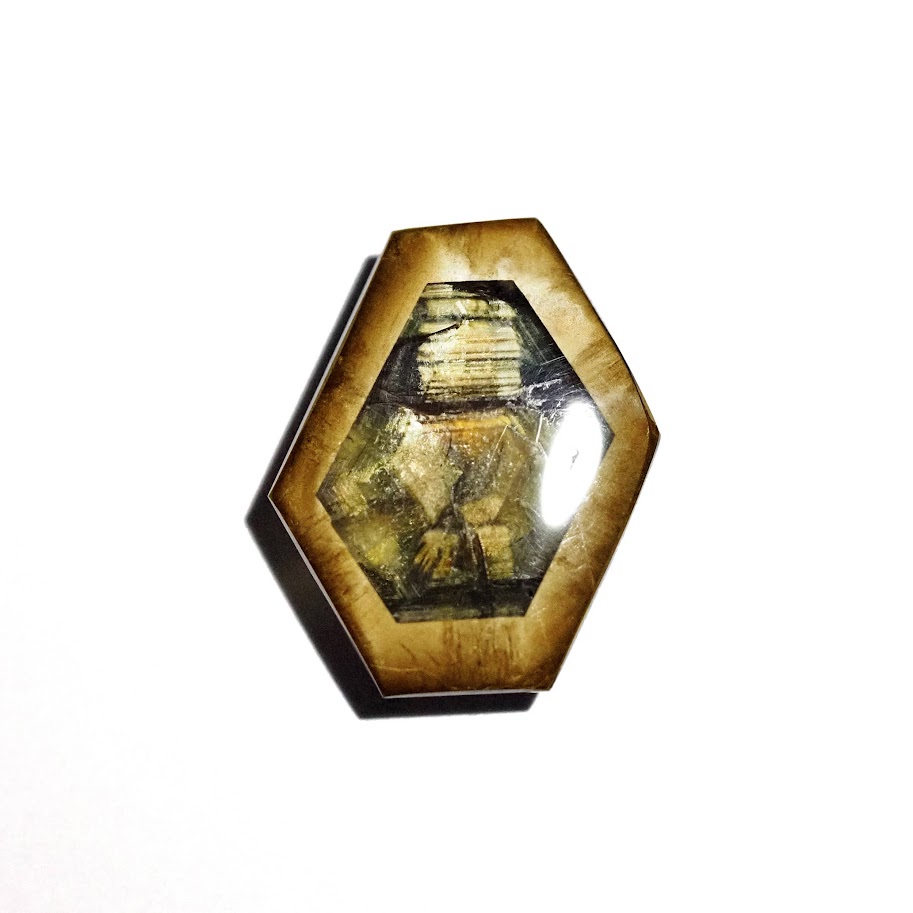
Over several days of experimenting with cutting angles, the right orientation revealed something no one had catalogued in sapphire before: a golden adularescence, moving across the stone's surface as it turned in the light. Convinced there was something genuinely new here, Khan went on to help finance the remaining mining operation and purchased its production.
By 2014, the deposit was exhausted. No further rough has entered the market since — what was mined in those five years is the entire supply that will ever exist.
Khan named the material for its defining feature and registered "Gold Sheen™" as an international trademark.
Independent research into the rarity of Gold Sheen Sapphire is underway, with findings expected to be published in the coming months.
Registered by the Smithsonian.
Before bringing the gems to market, Khan had them examined by laboratories across the gemological trade — GIA, AIGS, GIT, TGL, GRS, Lotus Gemology, AGL, SSEF, ICA GemLab, and IGL among them. Every result confirmed the same thing: a natural, untreated species of sapphire exhibiting a golden sheen not previously documented in corundum.
In 2018, at the AGTA GemFair in Tucson, the Smithsonian Institution's National Gem and Mineral Collection registered Gold Sheen™ as a new variety of corundum and added a sample to its permanent collection — photographed there with curator Jeffrey Post.
Covered in the trade and scientific literature.
Since 2015, Gold Sheen™ sapphire has been the subject of peer-reviewed gemological research and trade-press features. A selection:
Bui, Deliousi, Malik & Corte, "From exsolution to 'Gold Sheen': A new variety of corundum," Vol. 34, No. 8, 2015 — the first comprehensive scientific study.
View PDFGIA, "Update on Spectroscopy of 'Gold Sheen' Sapphires," Winter 2016, Vol. 52, No. 4 — laboratory analysis of 14 stones.
View PDFGIA Gem News International, "Update on trace-element chemical characteristics of golden sheen sapphire," Summer 2018, Vol. 54 — 23 stones analysed at GIA Tokyo.
View PDFGem-A, "Shimmering Sapphires" by Thanh Nhan Bui, Winter 2018, Vol. 27, No. 4 — cover feature exploring colour, transparency, and value.
View PDFICA, "Gold Sheen Sapphires — From Gold Mine to Market" by Cynthia Unninayar, Summer 2018, Issue 38.
View PDFNarudeesombat et al., "Golden Sheen and Non-Sheen Sapphires from Kenya," Gem and Jewelry Institute of Thailand — inclusion and spectroscopy study.
View PDFEach "View PDF" opens the original scan directly for reading — these are shared here as coverage of our own material, with copyright remaining with the original publisher in each case.
Set by designers, worn on the awards stage.
Since appearing at gem shows in Bangkok, Hong Kong, and Tucson, Gold Sheen™ sapphire has been set by David Yurman and featured in pieces by John Hardy and designer Brenda Smith.
A Gold Sheen™ sapphire ring by William Travis Designs won the American Gem Trade Association's Savor Silver Award for Men's Jewelry.
Pricing.
Gold Sheen Sapphire™ prices generally range from US$800 to over US$5,000 per carat for good-to-rare qualities, while extremely rare pieces start at US$6,000 and may go up to US$25,000 per carat and beyond — a reflection of a single, closed source that will never be replenished.
Good / Very Good Grade
US$800 – 1,200 / carat
The most accessible entry into a genuine, natural Gold Sheen Sapphire™ — a visible golden sheen with modest transparency or size. Still drawn from the same single Kenyan deposit that stopped producing in 2014.
Fine to extra fine
US$1,000 – 3,000 / carat
The entry point for genuinely collectible material — a clear, well-formed golden sheen with decent transparency. Even at this tier, every stone is drawn from a deposit that stopped producing in 2014.
Rare
US$3,500 – 5,000 / carat
Stronger, more evenly distributed sheen across the stone, better size, or the first hints of secondary color — the "Aurora Effect" flashes of blue or green layered over the gold — that most stones don't show.
Extremely rare
from US$6,000 / carat — may go up to US$25,000 and beyond
Exceptional clarity paired with a vivid, uniform sheen, typically in larger carat weights. This is the tier sought by serious collectors and institutions, and increasingly acquired as investment pieces given the deposit's permanent closure — the same caliber of material the Smithsonian added to its permanent collection.
Key price determinants.
-
Carat weight
Larger stones command exponential premiums — the deposit's exhaustion means large, high-quality rough will never be replaced.
-
Treatment status
Every stone is 100% natural and unheated, confirmed across ten independent laboratories — there is no treated version of this material to discount against.
-
Sheen strength & colour
Vividness and evenness of the golden schiller, and — in rarer stones — the multicolour Aurora Effect, drive value more than any other single factor.
-
Asterism (star quality)
For cabochons displaying a six-rayed star, sharpness and centring of the star meaningfully increase value.
-
Certification
Reports from recognised independent laboratories verifying natural origin and treatment status are essential at the top of the market.
-
Source scarcity
The single Kenyan deposit is permanently exhausted — every carat in existence is part of a fixed supply with no path to renewal.
Ask directly for pricing on a specific stone.
Ask about a specific stone.
Send carat range, colour, or cut preference and we'll follow up with current availability and pricing.
Start an inquiry